
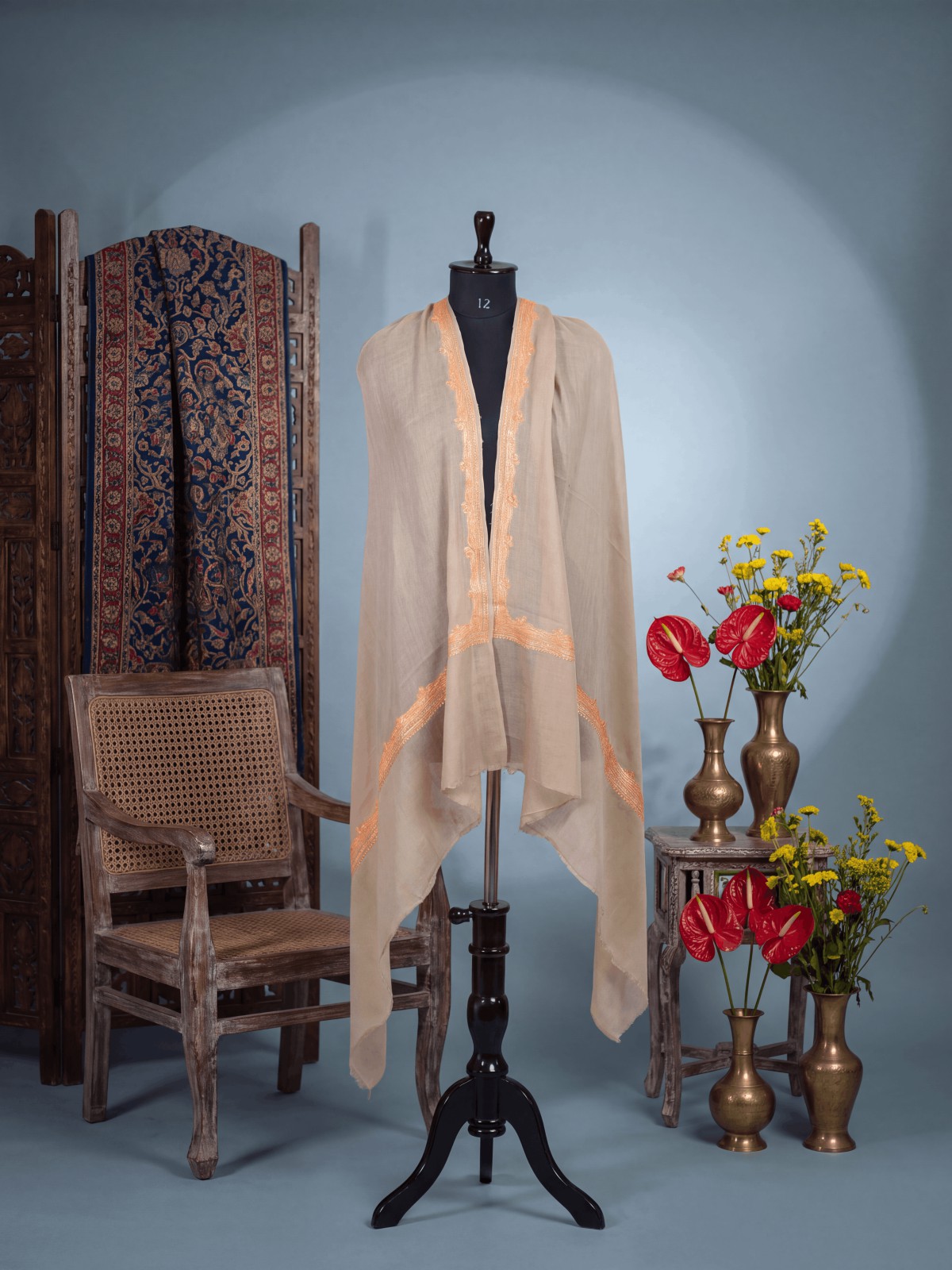
Few textiles carry as much mystique as Pashmina — and few are as widely misunderstood. The word is used loosely across the world, often for cloth that has never been near Kashmir. Knowing what genuine Pashmina actually is makes the difference between buying a shawl and inheriting one.
It starts on the high plateau
Pashmina comes from pashm, the fine undercoat grown by Changthangi goats on the cold, high plateaus of Ladakh and Central Asia. The animals grow it to survive winters far below freezing and shed it naturally as the weather turns. It is combed out by hand rather than sheared, and it is extraordinarily fine — which is exactly why it is so warm for its weight.
Sorting and spinning
Raw pashm arrives full of coarse guard hair that has to be separated out by hand, fibre by fibre, before anything can be spun. The yarn that results is too delicate for high-speed industrial looms. That is not a marketing position; it is the practical reason true Pashmina is still woven by hand.
How to recognise the real thing
- It is light, not bulky. Warmth out of all proportion to weight is the giveaway.
- It is not perfectly uniform. Handspun yarn and handloom weaving leave subtle irregularities. Machine-perfect regularity is a warning sign, not a mark of quality.
- It has a soft matte glow rather than a hard synthetic shine.
- It comes with provenance. Ask who made it and where. A seller who cannot answer is a seller to avoid.
Why it costs what it costs
A genuine Pashmina shawl represents combed fleece, hand sorting, hand spinning and hand weaving — many hours of skilled human work before anyone picks up an embroidery needle. The price reflects labour, not branding.
At NOUR, 10% of our profits go directly to supporting artisan communities. When you buy a shawl, you are paying for a tradition to continue.
Leave a comment